Odds of a recession appear low | Bob Doll

Sensible view from Bob Doll:

…The odds of a recession appear low, but so does a significant acceleration in growth. The regulatory environment is loosening, consumer spending appears solid and jobs growth remains strong. As such, we do not expect a recession any time soon. At the same time, however, we see no catalyst to push the economy into a higher gear unless the White House and Congress make progress on their pro-growth agenda.

Progress on tax reform would revive the bulls.

Source: Weekly Investment Commentary from Bob Doll | Nuveen

Nasdaq and S&P500 meet resistance

July labor stats are out and shows the jobless rate fell to a 16-year low at 4.3%. Unemployment below the long-term natural rate suggests the economy is close to capacity and inflationary pressures should be building.

Unemployment below the long-term natural rate

Source: St Louis Fed, BLS

But hourly wage rates are growing at a modest pace, easing pressure on the Fed to raise interest rates.

Hourly Wage Rates

Source: St Louis Fed, BLS

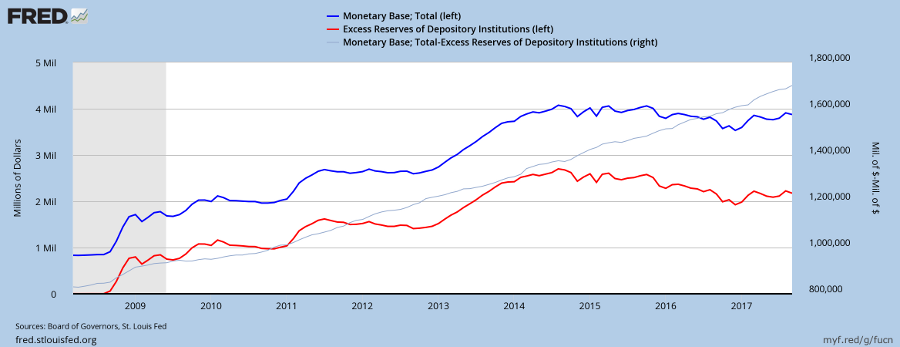
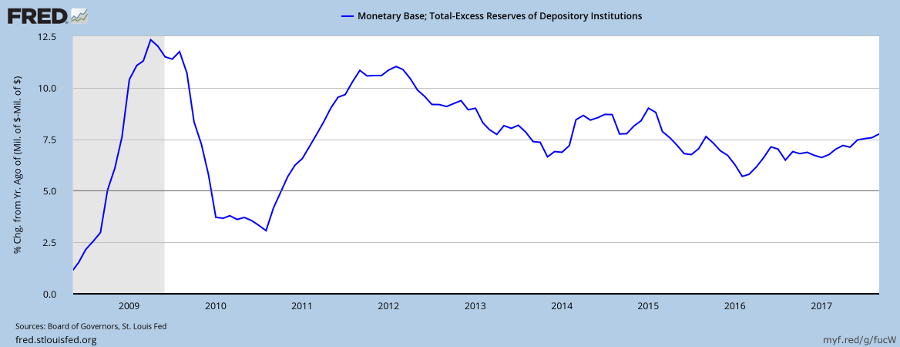
Fed monetary policy remains accommodative, with the monetary base (net of excess reserves) growing at a robust 7.5% a year.

Hourly Wage Rates

Source: St Louis Fed, FRB

Our forward estimate of real GDP — Nonfarm Payroll * Average Weekly Hours — continues at a slow but steady annual pace of 1.79%.

Real GDP compared to Nonfarm Payroll * Average Weekly Hours

Source: St Louis Fed, BLS & BEA

The Nasdaq 100 has run into resistance at 6000. No doubt readers noticed Amazon [AMZN] and Alphabet [GOOG] both retreated after reaching the $1000 mark. This is natural. Correction back to the rising trendline would take some of the heat out of the market and provide a solid base for further gains. Selling pressure, reflected by declining peaks on Twiggs Money Flow, appears secondary.

Nasdaq 100

The S&P 500 is also running into resistance, below 2500. Bearish divergence on Twiggs Money Flow warns of moderate selling pressure but this again seems to be secondary — in line with a correction rather than a reversal.

S&P 500

Target 2400 + ( 2400 – 2300 ) = 2500

Australia: Housing, Incomes & Growth

A quick snapshot of the Australian economy from the latest RBA chart pack.

Disposable income growth has declined to almost zero and consumption is likely to follow. Else Savings will be depleted.

Disposable Income & Consumption

Residential building approvals are slowing, most noticeably in apartments, reflecting an oversupply.

Residential Building Approvals

Housing loan approvals for owner-occupiers are rising, fueled no doubt by State first home-buyer incentives. States do not want the party, especially the flow from stamp duties, to end. But loan approvals for investors are topping after an APRA crackdown on investor mortgages, especially interest-only loans.

Housing loan approvals

The ratio of household debt to disposable income is precarious, and growing worse with each passing year.

Household debt to disposable income

House price growth continues at close to 10% a year, fueled by rising debt. When we refer to the “housing bubble” it is really a debt bubble driving housing prices. If debt growth slows so will housing prices.

House price growth

Declining business investment, as a percentage of GDP, warns of slowing economic growth in the years ahead. It is difficult, if not impossible, to achieve productivity growth without continuous new investment and technology improvement.

Business investment

Yet declining corporate bond spreads show no sign of increased lending risk.

Corporate bond spreads

Declining disposable income and consumption growth mean that voters are unlikely to be happy come next election. With each party trying to ride the populist wave, responsible economic management has taken a back seat. Throw in a housing bubble and declining business investment and the glass looks more than half-empty.

Every great cause begins as a movement, becomes a business, and eventually degenerates into a racket.

~ Eric Hoffer

China holds its head above water

A quick snapshot from the latest RBA chart pack.

Manufacturing is holding its head above water (50 on the PMI chart) and industrial production shows a small upturn but investment growth is falling, as in many global economies including the US and Australia. Retail sales growth has declined but remains healthy at 10% a year.

China

Electricity generation continues to climb but steel, cement and plate glass production all warn that real estate and infrastructure development are slowing.

China

Interest rates remain accommodative.

China

Real estate price growth is slowing but remains an unhealthy 10% a year. Real estate development investment rallied in response to lower interest rates but is clearly in a long-term decline.

China

There are no signs of an economy in immediate trouble but there are indications that the real estate and infrastructure boom may be ending. Through a combination of fiscal stimulus and accommodative monetary policy the Chinese have managed to stave off a capitalism-style correction. But failure to clear some of the excesses of the past decade will mean that the inevitable correction, when it does come, is likely to display familiar Asian severity (Japan 1992, Asian Crisis 1997).

ASX banks spoil the iron ore party

I underestimated the strength of iron ore which has now broken resistance at 70, suggesting that a bottom is forming. Strength of the latest rally indicates that the next correction is likely to find support at 60.

Iron Ore

The Resources sector responded, with the ASX 300 Metals & Mining index headed for a test of its February high at 3200 after recovering above support at 3000.

ASX 300 Metals & Mining

Banks have been on the receiving end, however, with the ASX 300 Banks index testing short-term support at 8500. A Twiggs Money Flow peak below zero warns of strong selling pressure. Breach of 8500 would signal another test of primary support at 8000.

ASX 300 Banks

The ASX 200 continues to form a narrow line, consolidating between 5600 and 5800. Declining Twiggs Money Flow, with a peak below zero, warns of selling pressure. Breach of support at 5600 remains likely, despite the iron ore rally, and would signal a primary down-trend.

ASX 200

Why is it so hard to forecast interest rates? | San Francisco Fed

Interesting paper by Michael Bauer at the San Francisco Fed:

….The difficulty of predicting changes in interest rates mainly arises from two features that characterize their evolution over time. First, like other financial variables, interest rates vary widely from day to day, which makes them difficult to link to economic fundamentals such as monetary or fiscal policy. This well-documented “excess volatility,” was first pointed out in Shiller (1979), and it reflects the importance of frequent changes in investor sentiment due to a never-ending stream of economic data releases and other news.

Second, as evident from 10-year Treasury yields since 1971, seen in Figure 1, interest rates have not fluctuated around a stable average level over this period. Instead of “mean reversion” around a constant average, they exhibit slow-moving trends, such as the rise during the “Great Inflation” period of the 1970s, and the long-lasting decline since then.

….the gap model does not assume that the level of the series will revert to some constant mean, but instead that the gap between the series and its trend component will revert to zero. Estimating trend components and gaps underlies most macroeconomic forecasting, and Faust and Wright (2013) recently demonstrated the gap model’s excellent performance for inflation forecasting.

….Since inflation is ultimately determined by monetary policy, the long-run inflation trend corresponds to the perceived inflation target of the central bank. This can be estimated reasonably well from surveys. Figure 1 plots the publicly available and mostly survey-based inflation trend estimate (red line) that underlies the Federal Reserve Board’s structural model of the U.S. economy, FRB/US. For the trend in the real interest rate, also called the natural or equilibrium real interest rate, Laubach and Williams (2003) suggested a way to estimate it from macroeconomic data and popularized its use in policy analysis (see also Williams 2016). Figure 1 includes an estimate of the equilibrium real interest rate (green line) taken as the average of several popular estimates, as discussed in Bauer and Rudebusch (2017).

Figure 1 also plots the sum of these two trends (red line); this estimate of the trend component in interest rates has exhibited a very pronounced decline since the 1980s. The 10-year yield generally fluctuated near this trend, and both are currently very low in historical comparison, with important consequences for policymaking (Williams 2016). Figure 1 suggests that it may be useful to take into account the level of the trend when forecasting interest rates.

….the final piece required for a practical forecast rule is an assumption about the transition of interest rates to their trend. Based on how quickly interest rates have historically reverted back to the trend, a reasonable assumption to make for this forecasting exercise is that 20% of the remaining gap is closed each quarter. But the precise speed of reversion to the trend is typically not crucial for forecasting performance (Faust and Wright 2013). Furthermore, it becomes essentially irrelevant for long-horizon forecasts, since forecasts are approximately equal to the estimated trend…..

Source: Federal Reserve Bank of San Francisco |

ASX stalls

Iron ore is testing resistance at 70. Respect would warn of another test of primary support at 53, while breakout would suggest that a bottom is forming and the next correction is likely to find support at 60.

Iron Ore

The Resources sector remains wary, with the ASX 300 Metals & Mining index retreating after a false break above resistance at 3050.

ASX 300 Metals & Mining

The ASX 300 Banks index retraced from resistance at 8800, heading for a test of the rising trendline and short-term support at 8500. Twiggs Money Flow continues to warn of selling pressure despite indications from APRA that they are unlikely to require further capital raising. Reversal below 8500 would warn of another test of primary support at 8000.

ASX 300 Banks

The ASX 200 has stalled, consolidating between 5600 and 5800 over the last two months. Declining Twiggs Money Flow, with a peak below zero, warns of selling pressure. Breach of support at 5600 is more likely, with an ensuing down-trend, but a lot depends on how iron ore behaves in the next few weeks.

ASX 200

It ain’t what you don’t know that gets you into trouble. It’s what you know for sure that just ain’t so.

~ Mark Twain (Samuel Clemens)

Nasdaq soars

GDP results for the second quarter of 2017 reflect recovery from the soft patch in 2016.

Nominal GDP compared to Nonfarm Payroll * Average Weekly Hours * Average Hourly Rate

Source: St Louis Fed, BLS & BEA

Nominal GDP for Q2 improved to 3.71%, measured annually. This closely follows our intial estimate calculated from Nonfarm Payroll * Average Weekly Hours * Average Hourly Rate.

Real GDP, after adjustment for inflation, also improved, to a 2.1% annual rate.

Real GDP compared to Nonfarm Payroll * Average Weekly Hours

Source: St Louis Fed, BLS & BEA

Bellwether transport stock Fedex is undergoing a correction at present but selling pressure appears moderate. Respect of medium-term support at 200 is likely and would confirm the primary up-trend (and rising economic activity).

Fedex

The Nasdaq 100 gained more than 20% year-to-date, from 4863 at end of December 2016 to 5908 on July 28th. Growth since 2009 has been consistent at around 20% a year but now appears to be accelerating. To my mind that warns sentiment may be running ahead of earnings, increasing the risk of a major adjustment. But there is no indication of this at present.

Nasdaq 100

The S&P 500 continues its advance towards 2500 at a more modest pace. Bearish divergence on Twiggs Money Flow warns of selling pressure but this seems to be secondary in nature, with the indicator holding well above zero.

S&P 500

Target 2400 + ( 2400 – 2300 ) = 2500

Bob Doll: Lack of  infrastructure stimulus might benefit stocks

Bob Doll at Nuveen makes a good point about Trump’s failure to get infrastructure spending through the House.

Washington, D.C. seems mired in gridlock, despite the fact that Republicans control the House, Senate and White House. No significant economic legislation has been passed, and the optimism from January about health care reform, infrastructure spending and tax cuts has all but vanished. Political attention will soon be focused on the 2018 midterm elections, and the window for pro-growth policy action is closing.

The lack of fiscal stimulus is disappointing, but it comes with a silver lining: We are unlikely to see the significant and sharp advance in interest rates or in the U.S. dollar that would probably result from such stimulus. The lost opportunity on the political front might therefore have the ironic effect of prolonging the bull market in stocks.

It seems crazy when you consider that both Clinton and Trump campaigned on a platform of major infrastructure programs to boost the economy. Just shows how dysfunctional Washington has become.

But I agree with the silver lining. Infrastructure spending would have boosted employment — the US is already below its long-term natural rate of unemployment — and upward pressure on wage rates. Which would have drawn a sharp increase in interest rates from the Fed, to combat inflation. Populist policies often ignore the hidden/unforeseen consequences and can produce the opposite result to that intended.

Unemployment v. LT Natural Rate

Source: Weekly Investment Commentary from Bob Doll | Nuveen

Stronger dollar, weaker inflation could check rate hawks

Jens Meyer at the AFR says that a stronger Dollar and low inflation are likely to prevent the RBA from raising interest rates for some time:

Inflation is expected to remain below the Reserve Bank’s comfort zone when second-quarter CPI data is unveiled on Wednesday. Despite a jump in vegetable prices due to damage caused by Cyclone Debbie, economists predict consumer prices rose just 0.4 per cent over the second quarter and 2.2 per cent over the year.

More importantly for the central bank, ongoing softness in wages growth is tipped to have kept a cap on the less volatile core inflation, coming in at 0.5 per cent over the quarter and 1.8 per cent over the year, below the Reserve Bank’s target band of 2 to 3 per cent.

Rising iron ore prices helped the Aussie Dollar break long-term resistance at 78 cents, testing 80 against the greenback. This goes against the wishes of the RBA who need a weaker Dollar to assist exports and boost import substitution.

Aussie Dollar

But the RBA is in a cleft stick. It cannot lower rates in order to weaken the Dollar as this would encourage speculative borrowing and aggravate the property bubble. It also can’t raise rates when inflation is low, the Aussie Dollar is strong and the economy is weak. Like Mister Micawber in Charles Dickens’ David Copperfield, the RBA has to sit and wait in the hope that something turns up.

Source: Stronger dollar, weaker inflation could check rate hawks