China hot money heads for the exit

Huw McKay at Westpac writes:

“The Jan-Feb FX positions of China’s banks imply that FX reserves fell in the early part of the year, despite back to back monster trade surpluses of $US60 billion. The logical conclusion is that money flowed out in a big way on the financial account.”

There are two reasons why capital would flow out on the financial account. The usual explanation is the PBOC buying US Treasuries, exporting capital to prevent the yuan appreciating against the Dollar. But Huw points out that the PBOC balance sheet shows a slight decline in foreign assets held. This could be a smokescreen, with investments channeled through an intermediary. Otherwise, it could be a sign that private capital is leaving for safer shores. This from the Business Times:

More than 76,000 Chinese millionaires emigrated or acquired citizenship of another country in the decade through 2013 amid global expansion by the nation’s companies.

Australia was among the most favored destinations, broker Knight Frank LLP said on Thursday, citing data compiled by law firm Fragomen LLP. The Chinese accounted for more than 90 percent of applications for the country’s significant investor visa in the two years to the end of January, representing 1,384 people. They also make the most applications for high-net-worth visas in the UK and the US.

Consumer confidence is below 2008/2009 levels and declining.

Crude breaks support

Nymex light crude (April 2015 contract) broke support at $45/barrel, warning of a decline to $35/barrel*.

Nymex WTI Crude

* Target calculation: 45 – ( 55 – 45 ) = 35

Why our prep-school diplomats fail against Putin and ISIS | New York Post

Kerry and Putin

“Why do our “best and brightest” fail when faced with a man like Putin?” Ralph Peters asks. “Or with charismatic fanatics? Or Iranian negotiators? Why do they misread our enemies so consistently, from Hitler and Stalin to Abu Bakr al-Baghdadi, the Islamic State’s self-proclaimed caliph?”

The answer is straightforward:

Social insularity: Our leaders know fellow insiders around the world; our enemies know everyone else.

The mandarin’s distaste for physicality: We are led through blood-smeared times by those who’ve never suffered a bloody nose.

And last but not least, bad educations in our very best schools: Our leadership has been educated in chaste political theory, while our enemies know, firsthand, the stuff of life.

Above all, there is arrogance based upon privilege. For revolving-door leaders in the U.S. and Europe, if you didn’t go to the right prep school and elite university, you couldn’t possibly be capable of comprehending, let alone changing, the world…….

That educational insularity is corrosive and potentially catastrophic: Our “best” universities prepare students to sustain the current system, instilling vague hopes of managing petty reforms.

But dramatic, revolutionary change in geopolitics never comes from insiders. It’s the outsiders who change the world.

An Athenian general once wrote:

The state that separates its scholars from its warriors will have its laws made by cowards, and its fighting done by fools.

~ Thucydides (c. 460 BC – c. 400 BC)

Read more at Why our prep-school diplomats fail against Putin and ISIS | New York Post.

Deflation in Australia?

The Eurozone experienced negative CPI growth over December/January.

CPI EU

Australia shows consumer price growth declining at the end of 2014. The next CPI update (Q1 2015), at end of April, is likely to reflect further slowing.

CPI Australia

Declining inflation expectations reported by Westpac (in the 0 to 5% range) tend to support this.

CPI expectations Australia (0 - 5% range)

CPI unwinds as the Fed runs out of “patience”

From Seeking Alpha:

The euro fell to a fresh 12-year low on Wednesday, extending a broad decline just days after the ECB launched its €1T bond-buying program, while the dollar index soared to its highest in more than 11 years at 98.95, buoyed by expectations that the Fed could soon lift U.S. interest rates. Nearly all now believe the FOMC will remove the word “patient” from its policy statement after its March 17-18 meeting, opening the door for a rate increase in June.

Not so fast. US consumer price growth (annual % change) to end of January 2015 fell below zero.

US CPI

Core CPI is slowing at a far gentler rate because it excludes energy prices (as well as food).

CPI Core

Wage pressures in the manufacturing sector are declining, despite solid job numbers, indicating there is still plenty of slack.

Manufacturing Hourly Earnings

With inflationary pressures easing, why the haste to raise interest rates? I believe that Janet Yellen will move when the time is right. And not before.

Dad’s Army fumbles housing affordability | Macrobusiness

By Leith van Onselen — Published with kind permission from Macrobusiness.

Broken Window

After his shoddy effort yesterday defending Australia’s giant superannuation rortDad’s Army’s Robert Gottliebsen (“Gotti”), has backed Treasurer Hockey’s proposal to allow young home buyers to raid their superannuation accounts to purchase their first home:

Joe Hockey’s idea to allow first home buyers to use their superannuation to break into the housing market is not stupid…

Most young people in Australia are finding it impossible to gain a first home… we are watching a fundamental shift in the Australian landscape with huge implications for the intergenerational problem…

[Last weekend]…I found myself in the company of a typical first home buyer in today’s market… They can just manage a house or larger apartment but they are saddled with a huge mortgage…

So why would we not say to that couple: “you can invest up to $50,000 of your superannuation in your first home…

A whole generation of Australians could retire without a house because they are unable to get into the market…

A question, Gotti: What do you think the extra demand from first home buyers (FHBs) accessing their super would do to house prices? That’s right, it would raise them, making the scheme self-defeating, much like FHB grants did.

Meanwhile, young people’s retirement nest eggs would be put at risk, potentially increasing their reliance on the Aged Pension (increasing the burden on future taxpayers).

Thankfully, Business Spectator’s young gun, Callam Pickering, understands these issues, penning the following rebuke today:

Australia’s approach to housing is full of misguided policies and dumb ideas…

Australian housing policy can best be viewed as a remarkably successful anti-Robin Hood scheme. We take from the poor (usually those under 40) and give it to the wealthy (often but not always ‘baby boomers’).

Over the years we have introduced all sorts of dodgy schemes to continue this rort…

Allowing younger Australians to use their superannuation for a housing deposit would have a similar effect to the FHOG… It certainly did nothing to boost home ownership…

Exactly. How about policy address the root causes of unaffordable housing – tax lurks, supply constraints, loose capital rules, and over-investment by super funds – rather than applying a band aid solution that will impoverish young people further and fill the coffers of Gotti’s rent-class?

Colin’s Comment: In 1850 Frédéric Bastiat wrote an essay Ce qu’on voit et ce qu’on ne voit pas (That Which Is Seen and That Which Is Unseen) which describes the common mistake of politicians, economists and the general public when devising or assessing economic policy. They focus on the immediate, visible benefit and fail to consider the unseen, hidden costs.

Here is a simple video by Sam Selikoff that explains Bastiat’s Broken Window fallacy:

When good news is bad news

“The U.S. economy added 295,000 jobs in February, a strong gain that beat expectations by a mile. Unemployment fell to 5.5%.” You would expect stocks to surge on the strong employment numbers. Instead the S&P 500 fell 1.4% on Friday. Penetration of support at 2080 warns of a correction.

S&P 500 Index

I can only ascribe this to fear of a rate rise. The stronger the employment data, the closer the prospect of the Fed raising interest rates. But Janet Yellen is likely to err on the side of caution, only raising rates when she is sure that the economy is on a sound footing and inflationary pressures are rising. That is far from the case at present, despite the good job numbers.

There is plenty of short-term money in the market, however, that seems to think otherwise.

China’s infrastructure boom is over

China has been on a record-breaking infrastructure binge over the last decade, but that era is coming to an end. Fall of the Baltic Dry Index below its 2008 low illustrates the decline of bulk commodity imports like iron ore and coking and thermal coal, important inputs in the construction of new infrastructure and housing.

Baltic Dry Index

High-end commodities like copper held up far better since 2008, but they too are now on the decline.

Copper

With the end of the infrastructure boom, China’s economy may well prove to be a one-trick pony. Transition from a state-directed infrastructure ‘miracle’ to a broad-based consumer society will be a lot more difficult.

Grantham: Lower oil price is new normal | Macrobusiness

By Houses & Holes
Reproduced with kind permission from Macrobusiness.com.au

From Jeremy Grantham:

1234

The simplest argument for the oil price decline is for once correct. A wave of new U.S. fracking oil could be seen to be overtaking the modestly growing global oil demand.

It became clear that OPEC, mainly Saudi Arabia, must cut back production if the price were to stay around $100 a barrel, which many, including me, believe is necessary to justify continued heavy spending to find traditional oil.

The Saudis declined to pull back their production and the oil market entered into glut mode, in which storage is full and production continues above demand.

Under glut conditions, oil (and natural gas) is uniquely sensitive to declines toward marginal cost (ignoring sunk costs), which can approach a few dollars a barrel – the cost of just pumping the oil.

Oil demand is notoriously insensitive to price in the short term but cumulatively and substantially sensitive as a few years pass.

The Saudis are obviously expecting that these low prices will turn off U.S. fracking, and I’m sure they are right. Almost no new drilling programs will be initiated at current prices except by the financially desperate and the irrationally impatient, and in three years over 80% of all production from current wells will be gone!

Thus, in a few months (six to nine?) I believe oil supply is likely to drop to a new equilibrium, probably in the $30 to $50 per barrel range.

For the following few years, U.S. fracking costs will determine the global oil balance. At each level, as prices rise more, fracking production will gear up. U.S. fracking is unique in oil industry history in the speed with which it can turn on and off.

In five to eight years, depending on global GDP growth and how quickly prices recover, U.S. fracking production will start to peak out and the full cost of an incremental barrel of traditional oil will become, once again, the main input into price. This is believed to be about $80 today and rising. In five to eight years it is likely to be $100 to $150 in my opinion.

U.S. fracking reserves that are available up to $120 a barrel are probably only equal to about one year of current global demand. This is absolutely not another Saudi Arabia.

Saudi Arabia has probably made the wrong decision for two reasons:

First, unintended consequences: a price decline of this magnitude has generated a real increase in global risk. For example, an oil producing country under extreme financial pressure may make some rash move. Oil company bankruptcy might also destabilize the financial world. Perversely, the Saudis particularly value stability.

Second, the Saudis could probably have absorbed all U.S. fracking increases in output (from today’s four million barrels a day to seven or eight) and never have been worse off than producing half of their current production for twice the current price … not a bad deal.

Only if U.S. fracking reserves are cheaper to produce and much larger than generally thought would the Saudis be right. It is a possibility, but I believe it is not probable.

The arguments that this is a demand-driven bust do not seem to tally with the data, although longer term the lack of cheap oil will be a real threat if we have not pushed ahead with renewables.

Most likely though, beyond 10 years electric cars and alternative energy will begin to eat into potential oil demand, threatening longer-term oil prices.

Exactly right, though in my view the equilibrium price will be more like $50 than $30 for the next half decade.

Don’t miss the full report.

Putin Will Never Back Down | Institutional Investor’s Alpha

Excellent analysis of the situation in Eastern Europe by Bill Browder, founder of London-based Hermitage Capital Management:

I’m afraid that, based on the reasons behind Putin’s motivations for invading Ukraine in the first place, there is no chance that he will back down. To understand this, all it takes is a simple analysis of how this crisis unfolded.

First, Putin didn’t start this war because of NATO enlargement or historical ties to Crimea, as many analysts have stated. Putin started this war out of fear of being overthrown like Ukrainian president Yanukovych in February 2014. Yanukovych had been stealing billions from the state over many years, and the Ukrainian people finally snapped and overthrew him. Compared with Putin, Yanukovych was a junior varsity player in the field of kleptocracy. For every dollar Yanukovych stole, Putin and his cronies probably stole 50. Putin understands that if he loses power in Russia, he and his underlings will lose all the money they stole; he will lose his freedom and possibly even his life.

I believe that Bill is right. Putin was not reacting to EU or NATO encroachment (they were never a threat), but to Maidan. Especially when we read Michael McFaul’s (former ambassador to Russia) summation of Putin: “He is obsessed with the CIA…..With respect Ukraine he believes the US led the coup in the Ukraine. The Ukrainians had nothing to do with it. It was all the CIA.”

Former Ambassador to Russia Michael McFaul

….. Putin has never dealt with economic chaos before. Though some may argue that this will bring him to the table to negotiate with the West, in my opinion any negotiation would be seen as a sign of weakness and is therefore the last thing Putin would want to do.

Putin’s only likely response is to escalate in Ukraine and possibly open up new fronts in other countries where there are “Russians to protect.” But doing so will only harden the sanctions, leading to further economic pain in Russia — and further military adventures to distract Russia’s people from that pain.

I cannot imagine a scenario in which there is any compromise, because for Putin compromise means being overthrown. Judging from all of his actions to date, he is ready to destroy his country for his own self-preservation.

We should start preparing ourselves for a war in Europe that may spread well beyond the borders of Ukraine. The only Western response to this has to be containment. This all may sound alarmist, but I’ve spent the past eight years in my own war with Putin, and I have a few insights about him that are worth knowing.

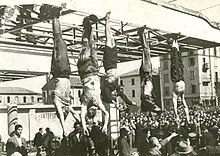
In Putin’s mind, he is fighting for survival. The US/EU/Nato and Ukraine are just a convenient scapegoat. His real enemy is the Russian people. This 1945 image of Benito Mussolini, his mistress Clara Petacci, and three others hanging outside a petrol station in Milan must haunt his dreams.
Bodies of Benito Mussolini, his mistress Clara Petacci, and three others hanging outside a petrol station in Milan

When they realize they have been duped, the anger of the Russian people will be palpable.

Read the full article at Unhedged Commentary: Putin Will Never Back Down | Institutional Investor's Alpha.