US & ASX Leading Indicators

US Stock Market

The composite valuation indicator uses the secondary axis on the right.

US Bull/Bear & Market Valuation Indicators

US Bull-Bear

We revised the bull-bear market leading indicator at the end of April 2026 to improve responsiveness by reducing it to a composite of five key indicators. Currently, two of the five indicators signal risk-off, indicating medium risk of a US bear market.

Bull/Bear Market Indicator

US Treasury Yield Curve

The 10-year/3-month Treasury yield spread has been positive for more than 120 days, and the S&P 500 is above its 12-month weighted moving average, confirming the risk-on signal.

Treasury Yields: 10-Year minus 3-Month

US Fed Funds Rate

The September FOMC meeting raised the fed funds rate target range to 3.75%-4.00%. The Fed Funds Rate signal is risk-on unless there has been a rate cut in the preceding 75 days.

Fed Funds Rate Target (Upper Limit)

US Stock Pricing

US stock pricing remains at extreme levels. We changed the composition of the Forward PE and Price-to-Sales indicators at the end of April 2026, so earlier highs are not directly comparable.

US Stock Market Value Indicator

We use z-scores to measure each indicator's current position relative to its historical data, with results expressed in standard deviations from the mean. We then average the five readings and convert that to a percentile. The higher the stock market price measure is relative to the historical mean, the greater the risk of a sharp drawdown.

US Value Buffett

Warren Buffett's favorite long-term measure of stock market valuation provides a stable valuation ratio largely unaffected by fluctuating profit margins.

The stock market capitalization-to-GDP ratio is more than double its long-term average of 1.2. Buffett considers values above 2.0 to indicate that stock prices are dangerously high.

Buffett Indicator: Stock Market Capitalization to GDP

US Value CAPE

Robert Shiller's CAPE smooths out business-cycle effects by comparing the S&P 500 index to a 10-year average of inflation-adjusted earnings.

The current advance on the CAPE ratio is the second-highest in history, behind only the 1999 peak during the Dotcom bubble at 44.2, with values far above its long-term average of 22.4.

Robert Shiller's S&P 500 CAPE Ratio

US Value PEmax

The S&P 500 Price-to-Earnings (PE) ratio, based on the highest trailing earnings, remains high when compared with the long-term average of 17.3.

S&P 500 PE of Highest Trailing Earnings

US Value Dow FPE

The Forward PE for stocks in the Dow Jones Industrial Average uses a 20% trimmed mean to mitigate the impact of outliers.

Dow Jones Industrials Forward Price-Earnings Ratio

US Value Dow Price-to-Sales

We use a 20% trimmed mean of the Price-to-Sales ratio across the 30 stocks in the Dow to remove the most extreme readings that would otherwise distort the ratio.

A change in the Dow Jones index composition on June 29, 2026 may have contributed to the recent jump, when Alphabet Inc. (GOOGL) replaced Verizon (VZ) in the index.

Dow Jones Industrials Price-to-Sales Ratio

Conclusion

The US Bull-Bear indicator, led by the transportation sector, indicates that the US economy is slowing but is not yet in a bear market, while the composite Stock Pricing indicator continues to warn that stocks are extremely over-priced.

ASX Stock Market

ASX Bull/Bear & Market Valuation Indicators

ASX Bull-Bear

The ASX Bull-Bear Leading Index signals a mild bear market.

ASX Bull/Bear Market Indicator

Australian leading indicators account for 40% of the ASX Leading Index, China for 20%, and the US Leading Index for the remaining 40%.

ASX Housing Approvals

The 3-month moving average of private housing approvals is well above its 20-year moving average (dotted line below), indicating a strong uptrend in the Australian housing sector.

Australian Private Housing Approvals

A cross of the 3-month MA (navy) below the 20-year MA (red) would signal risk-off.

ASX 200 Financials

The ASX 200 Financials Index (XFJ) remains below its 50-week weighted moving average, and a breach of primary support at 9000 would signal risk-off.

ASX 200 Financials Index

ASX 200 Real Returns

The ASX 200 is above its 50-week moving average relative to Gold, but the long-term downtrend continues, with no higher troughs. The signal remains risk-off.

ASX 200/Gold in Australian Dollars

Performance of the ASX 200 Index relative to Gold (in Australian Dollars) reflects the real return on Australian Stocks.

ASX China NBS Manufacturing

The Chinese NBS Manufacturing PMI increased to 50.1 in September from 49.8 in August. Values below 50 indicate a contraction, while a fall below 49.0 would signal risk-off.

China: NBS Manufacturing PMI

ASX Stock Pricing

ASX stock pricing bounced to 75.0% from 71.70% last week. Prices are still in a downtrend, but the decline is not a buy signal.

ASX Stock Market Value Indicator

We use z-scores to measure each indicator's current position relative to its historical data, with results expressed in standard deviations from the mean. We then average the five readings and convert that average to a percentile. The higher that stock market prices are relative to their historical mean, the greater the risk of a sharp drawdown.

ASX Value Buffett

Warren Buffett's favorite long-term valuation indicator compares stock market capitalization to GDP, providing a stable ratio with a long-term mean of 1.03.

ASX Market Capitalization/GDP

ASX Value Price-to-Sales

The Price-to-Sales ratio for stocks in the ASX 20 uses a 20% trimmed mean to remove the highest and lowest readings, which tend to distort the average.

ASX 20 Price to Sales with 20% Trimmed Mean

ASX Value FPE

The Forward Price-Earnings ratio for stocks in the ASX 20 uses a 20% trimmed mean to eliminate the highest and lowest readings. This avoids distortions of the average by outliers.

ASX 20 Forward PE with 20% Trimmed Mean

Conclusion

The ASX Bull-Bear indicator signals the early stages of a bear market, while the falling composite Stock Pricing indicator warns of a drawdown. China’s NBS Manufacturing PMI has crossed above 50 but the ASX 200 Financials Index is still testing primary support at 9000.

Related Links

Australian Growth: Performance Jul-2023

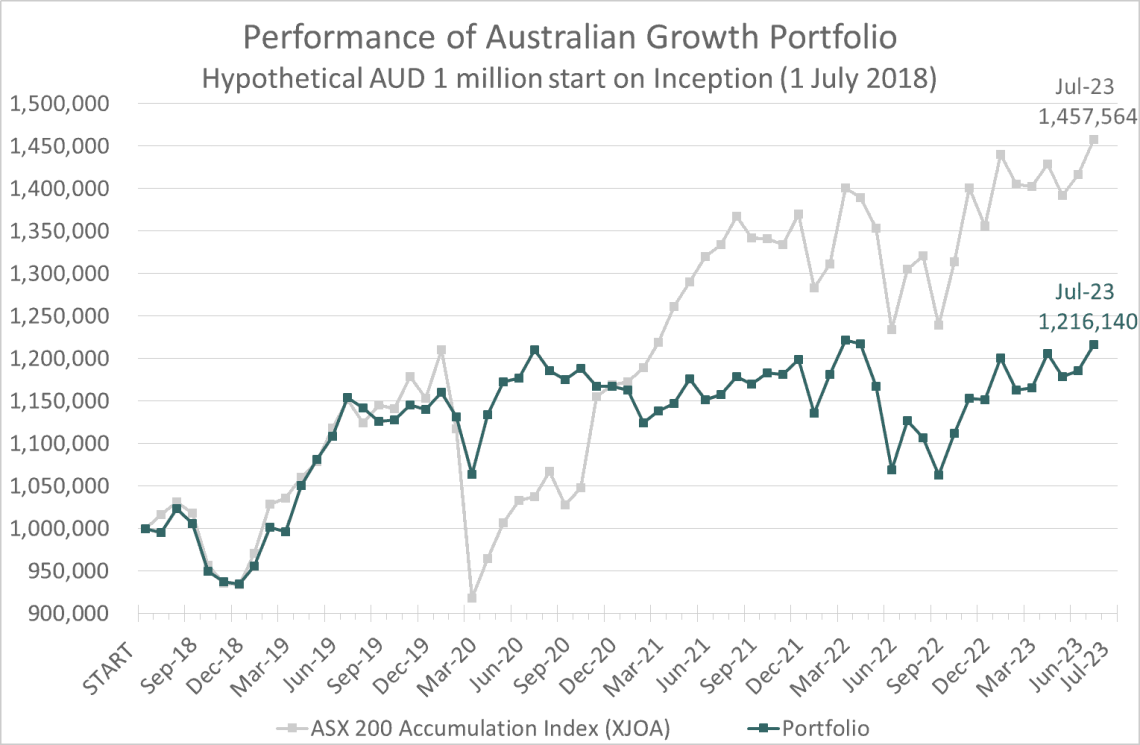
Australian Growth portfolio performance since inception on 1 July 2018 is set out below. We expect to hold most growth stocks for 5 to 10 years.
Australian Growth Annualized Performance 1-Jul-2018 to 31-Jul-2023: Portfolio 3.92%, ASX 200 Accumulation Index 7.69%

Individual Stocks

[Content protected for Premium, Australian Growth members only]

Past Performance

Hypothetical $1 million invested in the Australian Growth portfolio on 1 July 2018:

Hypothetical AUD 1 million invested on 1-Jul-2018 would have grown to 1.22 million by 31-Jul-23, compared to the ASX 200 Accumulation Index (XJOA) which would have grown to 1.46 million.

Performance Notes:

  • Performance is calculated in Australian Dollars.
  • Annualized performance is calculated using the CAGR formula.
  • Returns are calculated after brokerage costs but excludes all other fees and charges.
  • Franking credits are excluded from return calculations.
  • Not all stocks have equal weighting nor held for the full period.
  • Past performance is not a guarantee of future performance.

Portfolio Allocation

The graph below reflects current portfolio allocation:

Australian Growth Current Allocation

For a detailed discussion of target sectors see Changes to Australian portfolio allocation.

Past Allocations

Allocations have evolved over time to deal with elevated market risk, over-priced sectors, and opportunities in cyclicals:

Australian Growth Past Allocations

International Growth: Performance Jul-2023

International Growth portfolio performance since inception on July 1, 2018 is set out below. We expect to hold most growth stocks for 5 to 10 years.

International Growth Annualized Performance July 1, 2018 to July 31, 2023: Portfolio 9.65%, S&P 500 Total Return Index 12.9%

And in Australian Dollars:

International Growth in AUD Annualized Performance July 1, 2018 to July 31, 2023: Portfolio 11.72%, S&P 500 Total Return Index 15.04%

Performance of Individual Stocks

[Content protected for Premium, International Growth members only]

Past Performance

Hypothetical $1 million invested in the International Growth portfolio on July 1, 2018, calculated in US Dollars:

Hypothetical USD 1 million invested on July 1, 2018 would have grown to 1.6 million by July 31, 2023, compared to the S&P 500 Total Return Index (SPXT) which would have grown to 1.85 million.

Converted to Australian Dollars (on a month-end basis):

Hypothetical AUD 1.35 million (equivalent of USD 1 million) invested on July 1, 2018 would have grown to 2.38 million by July 31, 2023, compared to the S&P 500 Total Return Index (SPXT) which would have grown to 2.76 million.

Performance Notes:

  • Performance is calculated in US Dollars except where otherwise stated.
  • Annualized performance is calculated using the CAGR formula.
  • Returns are calculated after brokerage costs but exclude all other fees and charges.
  • Not all stocks have equal weighting nor held for the full period.
  • Past performance is not a guarantee of future performance.

Portfolio Allocation

The graph below reflects current portfolio allocation:

International Growth Current Allocation

For a detailed discussion of target sectors see Changes to International portfolio allocation.

Past Allocations

Allocations have evolved over time to deal with elevated market risk, over-priced sectors, and opportunities in cyclicals:

International Growth Past Allocations

International Growth: Performance Jun-2023

International Growth portfolio performance since inception on July 1, 2018 is set out below. We expect to hold most growth stocks for 5 to 10 years.

International Growth Annualized Performance July 1, 2018 to June 30, 2023: Portfolio 9.63%, S&P 500 Total Return Index 12.42%

And in Australian Dollars:

International Growth in AUD Annualized Performance July 1, 2018 to June 30, 2023: Portfolio 11.93%, S&P 500 Total Return Index 14.77%

Performance of Individual Stocks

[Content protected for Premium, International Growth members only]

Past Performance

Hypothetical $1 million invested in the International Growth portfolio on July 1, 2018, calculated in US Dollars:

Hypothetical USD 1 million invested on July 1, 2018 would have grown to 1.58 million by June 30, 2023, compared to the S&P 500 Total Return Index (SPXT) which would have grown to 1.8 million.

Converted to Australian Dollars (on a month-end basis):

Hypothetical AUD 1.35 million (equivalent of USD 1 million) invested on July 1, 2018 would have grown to 2.38 million by June 30, 2023, compared to the S&P 500 Total Return Index (SPXT) which would have grown to 2.69 million.

Performance Notes:

  • Performance is calculated in US Dollars except where otherwise stated.
  • Annualized performance is calculated using the CAGR formula.
  • Returns are calculated after brokerage costs but exclude all other fees and charges.
  • Not all stocks have equal weighting nor held for the full period.
  • Past performance is not a guarantee of future performance.

Portfolio Allocation

The graph below reflects current portfolio allocation:

International Growth Current Allocation

For a detailed discussion of target sectors see Changes to International portfolio allocation.

Past Allocations

Allocations have evolved over time to deal with elevated market risk, over-priced sectors, and opportunities in cyclicals:

International Growth Past Allocations

Australian Growth: Performance Jun-2023

Australian Growth portfolio performance since inception on 1 July 2018 is set out below. We expect to hold most growth stocks for 5 to 10 years.

Australian Growth Annualized Performance 1-Jul-2018 to 30-Jun-2023: Portfolio 3.47%, ASX 200 Accumulation Index 7.22%

Individual Stocks

[Content protected for Premium, Australian Growth members only]

Past Performance

Hypothetical $1 million invested in the Australian Growth portfolio on 1 July 2018:

Hypothetical AUD 1 million invested on 1-Jul-2018 would have grown to 1.19 million by 30-Jun-23, compared to the ASX 200 Accumulation Index (XJOA) which would have grown to 1.42 million.

Performance Notes:

  • Performance is calculated in Australian Dollars.
  • Annualized performance is calculated using the CAGR formula.
  • Returns are calculated after brokerage costs but excludes all other fees and charges.
  • Franking credits are excluded from return calculations.
  • Not all stocks have equal weighting nor held for the full period.
  • Past performance is not a guarantee of future performance.

Portfolio Allocation

The graph below reflects current portfolio allocation:

Australian Growth Current Allocation

For a detailed discussion of target sectors see Changes to Australian portfolio allocation.

Past Allocations

Allocations have evolved over time to deal with elevated market risk, over-priced sectors, and opportunities in cyclicals:

Australian Growth Past Allocations

International Growth: Performance May-2023

International Growth portfolio performance since inception on July 1, 2018 is set out below. We expect to hold most growth stocks for 5 to 10 years.

International Growth Annualized Performance July 1, 2018 to May 31, 2023: Portfolio 8.3%, S&P 500 Total Return Index 11.18%

And in Australian Dollars:

International Growth in AUD Annualized Performance July 1, 2018 to May 31, 2023: Portfolio 11.16%, S&P 500 Total Return Index 14.12%

Performance of Individual Stocks

[Content protected for Premium, International Growth members only]

Past Performance

Hypothetical $1 million invested in the International Growth portfolio on July 1, 2018, calculated in US Dollars:

Hypothetical USD 1 million invested on July 1, 2018 would have grown to 1.48 million by May 31, 2023, compared to the S&P 500 Total Return Index (SPXT) which would have grown to 1.68 million.

Converted to Australian Dollars (on a month-end basis):

Hypothetical AUD 1.35 million (equivalent of USD 1 million) invested on July 1, 2018 would have grown to 2.28 million by May 31, 2023, compared to the S&P 500 Total Return Index (SPXT) which would have grown to 2.59 million.

Performance Notes:

  • Performance is calculated in US Dollars except where otherwise stated.
  • Annualized performance is calculated using the CAGR formula.
  • Returns are calculated after brokerage costs but exclude all other fees and charges.
  • Not all stocks have equal weighting nor held for the full period.
  • Past performance is not a guarantee of future performance.

Portfolio Allocation

The graph below reflects current portfolio allocation:

International Growth Current Allocation

For a detailed discussion of target sectors see Changes to International portfolio allocation.

Past Allocations

Allocations have evolved over time to deal with elevated market risk, over-priced sectors, and opportunities in cyclicals:

International Growth Past Allocations

Australian Growth: Performance May-2023

Australian Growth portfolio performance since inception on 1 July 2018 is set out below. We expect to hold most growth stocks for 5 to 10 years.

Australian Growth Annualized Performance 1-Jul-2018 to 31-May-2023: Portfolio 3.39%, ASX 200 Accumulation Index 6.96%

Individual Stocks

[Content protected for Premium, Australian Growth members only]

Past Performance

Hypothetical $1 million invested in the Australian Growth portfolio on 1 July 2018:

Hypothetical AUD 1 million invested on 1-Jul-2018 would have grown to 1.18 million by 31-May-23, compared to the ASX 200 Accumulation Index (XJOA) which would have grown to 1.39 million.

Performance Notes:

  • Performance is calculated in Australian Dollars.
  • Annualized performance is calculated using the CAGR formula.
  • Returns are calculated after brokerage costs but excludes all other fees and charges.
  • Franking credits are excluded from return calculations.
  • Not all stocks have equal weighting nor held for the full period.
  • Past performance is not a guarantee of future performance.

Portfolio Allocation

The graph below reflects current portfolio allocation:

Australian Growth Current Allocation

For a detailed discussion of target sectors see Changes to Australian portfolio allocation.

Past Allocations

Allocations have evolved over time to deal with elevated market risk, over-priced sectors, and opportunities in cyclicals:

Australian Growth Past Allocations

Australian Growth: Performance Apr-2023

Australian Growth portfolio performance since inception on July 1, 2018 is set out below. We expect to hold most growth stocks for 5 to 10 years.

Australian Growth Annualized Performance 1-Jul-2018 to 30-Apr-2023: Portfolio 3.94%, ASX 200 Accumulation Index 7.66%

Individual Stocks

[Content protected for Premium, Australian Growth members only]

Past Performance

Hypothetical $1 million invested in the Australian Growth portfolio on July 1, 2018:

Hypothetical AUD 1 million invested on July 1, 2018 would have grown to 1.21 million by April 30, 2023, compared to the ASX 200 Accumulation Index (XJOA) which would have grown to 1.43 million.

Performance Notes:

  • Performance is calculated in Australian Dollars.
  • Annualized performance is calculated using the CAGR formula.
  • Returns are calculated after brokerage costs but excludes all other fees and charges.
  • Franking credits are excluded from return calculations.
  • Not all stocks have equal weighting nor held for the full period.
  • Past performance is not a guarantee of future performance.

Portfolio Allocation

Current portfolio allocation differs from our target allocation due to medium-term technical trends and over-pricing in targeted sectors. For further details see Changes to Australian portfolio allocation.

Current Allocation

The graph below reflects current portfolio allocation:

Australian Growth Current Allocation

Past Allocations

Allocations have evolved over time to deal with elevated market risk, over-priced sectors, and opportunities in cyclicals:

Australian Growth Past Allocations

International Growth: Performance Apr-2023

International Growth portfolio performance since inception on July 1, 2018 is set out below. We expect to hold most growth stocks for 5 to 10 years.

International Growth Annualized Performance 1-Jul-2018 to 30-Apr-2023: Portfolio 8.45%, S&P 500 Total Return Index 11.29%

And in Australian Dollars:

International Growth in AUD Annualized Performance 1-Jul-2018 to 30-Apr-2023: Portfolio 10.97%, S&P 500 Total Return Index 13.88%

Performance of Individual Stocks

[Content protected for Premium, International Growth members only]

Past Performance

Hypothetical $1 million invested in the International Growth portfolio on July 1, 2018, calculated in US Dollars:

Hypothetical USD 1 million invested on July 1, 2018 would have grown to 1.48 million by April 30, 2023, compared to the S&P 500 Total Return Index (SPXT) which would have grown to 1.68 million.

Converted to Australian Dollars (on a month-end basis):

Hypothetical AUD 1.35 million (equivalent of USD 1 million) invested on July 1, 2018 would have grown to 2.24 million by April 30, 2023, compared to the S&P 500 Total Return Index (SPXT) which would have grown to 2.54 million.

Performance Notes:

  • Performance is calculated in US Dollars except where otherwise stated.
  • Annualized performance is calculated using the CAGR formula.
  • Returns are calculated after brokerage costs but exclude all other fees and charges.
  • Not all stocks have equal weighting nor held for the full period.
  • Past performance is not a guarantee of future performance.

Portfolio Allocation

Current portfolio allocation differs from our target allocation due to medium-term technical trends and over-pricing in targeted sectors. For further details see Changes to International portfolio allocation.

Allocations Changed Apr-2023

We have revised the allocation of some stocks held in the model portfolio. These changes have been applied to the current and past allocations below.

[Content protected for Premium, International Growth members only]

Current Allocation

The graph below reflects current portfolio allocation:

International Growth Current Allocation

Past Allocations

Allocations have evolved over time to deal with elevated market risk, over-priced sectors, and opportunities in cyclicals:

International Growth Past Allocations

International Growth: Performance Mar-2023

International Growth portfolio performance since inception on July 1, 2018 is set out below. We expect to hold most growth stocks for 5 to 10 years.

International Growth Annualized Performance 1-Jul-2018 to 31-Mar-2023: Portfolio 8.96%, S&P 500 Total Return Index 11.13%

And in Australian Dollars:

International Growth in AUD Annualized Performance 1-Jul-2018 to 31-Mar-2023: Portfolio 11.29%, S&P 500 Total Return Index 13.5%

Performance of Individual Stocks

[Content protected for Premium, International Growth members only]

Past Performance

Hypothetical $1 million invested in the International Growth portfolio on July 1, 2018, calculated in US Dollars:

Hypothetical USD 1 million invested on July 1, 2018 would have grown to 1.5 million by March 31, 2023, compared to the S&P 500 Total Return Index (SPXT) which would have grown to 1.65 million.

Converted to Australian Dollars (on a month-end basis):

Hypothetical AUD 1.35 million (equivalent of USD 1 million) invested on July 1, 2018 would have grown to 2.25 million by March 31, 2023, compared to the S&P 500 Total Return Index (SPXT) which would have grown to 2.47 million.

Performance Notes:

  • Performance is calculated in US Dollars except where otherwise stated.
  • Annualized performance is calculated using the CAGR formula.
  • Returns are calculated after brokerage costs but exclude all other fees and charges.
  • Not all stocks have equal weighting nor held for the full period.
  • Past performance is not a guarantee of future performance.

Portfolio Allocation

Current portfolio allocation differs considerably from our target allocation, set as a long-term aspirational goal, due to elevated market risk, over-priced sectors, and opportunities in cyclicals (including gold and precious metals).

Current Allocation

The graph below reflects current portfolio allocation:

International Growth Current Allocation

Past Allocations

Allocations have evolved over time to deal with elevated market risk, over-priced sectors, and opportunities in cyclicals:

International Growth Past Allocations