Philip Parker – veteran fund manager decides to sell all shares in Altair’s Trusts to hand back cash and hands back mandates for SMA/IMA’s and also sells MDA family office mandates to cash from shares.
Why?
AUSTRALIAN EAST COAST PROPERTY MARKET BUBBLE AND THE IMPENDING CORRECTION
CHINA PROPERTY AND DEBT ISSUES LATER THIS YEAR
THE OVERVALUED AUSTRALIAN EQUITY MARKETS AND
OVERSIZED GEO-POLITICAL RISKS AND AN UNPREDICTABLE US POLITICAL ENVIRONMENT
The underlined above are some of the more obvious reasons to exit the riskier asset markets of shares and property – in my opinion.
As a result of the above and after 25 years as a fund manager and 30 years in this industry I am taking around 6 to 12 months off. The main reason is in my opinion that there are just too many risks at present, and I cannot justify charging our clients fees when there are so many early warning lead indicators of clear and present danger in property and equity markets now….
Re-published with kind permission from Macrobusiness.
The Age has run a disturbing report on the collapse of TAFE enrollments, driven in part by the uncapping of university places and the bubble in dodgy private Vocational Education and Training (VET) providers:
…[Tafe] enrolments [are] down by up to 40 per cent at some providers, two years after [Victorian] Premier Daniel Andrews promised to “rebuild” TAFE…
Some TAFE buildings resemble ghost campuses, rather than thriving centres of learning…
According to the Education Union, 3300 teachers have left the Victorian TAFE system in the past five years.
…annual reports also reveal that in the past year alone, enrolments have plummeted: Sunraysia Institute had a 21 per cent drop, student numbers were down 12 per cent at GOTAFE, and Melbourne Polytechnic experienced a staggering 40 per cent drop in enrolments…
Bruce Mackenzie, who led the state government’s review into the training sector… says private training college scandals have unfairly tarnished TAFE’s reputation, while a decline in apprenticeships and the uncapping of university places has also driven students away.
“The second tier universities take anyone into their course whether they are suitable or not, which rips the heart out of TAFE institutes,” he says…
But that mess, according to the AEU, started when the Brumby government created an open market system in 2008, paving the way for an explosion in private providers and rorting.
“The contestable policy will always undermine the TAFE system,” says Mr Barclay…
The collapse in TAFE numbers is worrying on several levels.
Recent data released by the National Centre for Vocational Education Research (NCVER) revealed that traineeship and apprenticeship commencements have fallen by more than 45% over the past four years:
Apprenticeship completions have also fallen heavily, down by 24.0% in the 12 months to March 2016.
Meanwhile, the Department of Employment’s most recent skills shortages report showed that “skills shortages”, while low overall, are far more widespread for technicians and tradespeople:
Because they are experiencing relatively few commencements and completions of apprenticeships:
By contrast, the economy is awash with university students, with nearly 730,000 enrolled in a bachelor degree:
Despite graduate employment outcomes falling to “historically low levels”:
Students numbers studying at private VET colleges also soared, guzzling-up public funds via VET FEE-HELP loans and diverting students away from public TAFEs.
As shown below, nearly three-quarters of VET students were enrolled in private colleges in 2015:
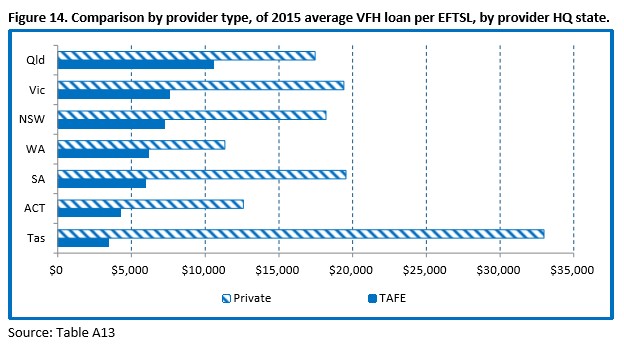
And these private colleges charged an average loan amount well above that of public TAFEs:
They also charged average tuition fees of $18,290 versus $7,642 for public TAFEs, as well as accumulated total VET FEE-HELP loans of $2,400 million in 2015, versus just $402 million for public TAFEs:
However, despite the huge imbalance between student numbers, fees charged, and funding, only 14,400 students managed to complete courses at private colleges in 2014, compared with 18,400 students at TAFE and other public providers.
Clearly, Australia’s higher education system is a complete mess. The implementation of demand-driven training systems across Australia has effectively led to an explosion of students studying at university – creating a glut of bachelor-qualified people – as well as students studying expensive diplomas at dodgy private providers. At the same time, a commensurate shortage in people with trade skills has developed, due in part to the decline in TAFE.
What has been delivered is a wasteful, rorted higher education system that has delivered a huge Budget blow-out, poor educational outcomes, and the wrong skills for the nation.
In an ideal world we’d be investing more in our universities, but our world is far from ideal. And so are our unis. They’re inefficient bureaucracies, with bloated administrations and over-paid vice chancellors….
It’s true our unis are obsessed by research, but any innovation this leads is almost accidental. The research the unis care about is papers published in prestigious foreign journals, which they see as the path to what they’re really striving for: a higher ranking on the various international league tables of universities….
The unsatisfactory state of our unis is partly the product of our federal politicians’ – Labor and Coalition – decades-long project to quietly and progressively privatise our universities via the backdoor.
Like so much misconceived micro-economic reform, this project hasn’t worked well. Put a decades-long squeeze on unis’ government funding and what happens? The unis intensify their obsess with research status-seeking and do it by exploiting their market power over students – while building ever larger bureaucracies.
There are some excellent teachers in universities, but they’re the exception. The unis pretend to value good teachers – and award tin medals to prove it – but, in truth, there are no promotions for being a good teacher.
Students are seen as a necessary evil, needed because the public thinks teaching their kids is the main reason for continuing to feed academics….
Universities are gaming the system, maximizing fee revenue by focusing on international rankings while lowering entrance requirements for students.
There is too much emphasis on a ‘prestigious’ university education and not enough on its practical application. Many students would benefit more from studying at technical institutes (many now rebranded as technical or polytechnic universities), technical colleges, TAFE or technikons which offer a balance between practical experience and theoretical studies. This includes not only engineering but architecture, nursing, finance, IT, education, and many other disciplines.
Germany’s DAX is retracing to test its new support level at 12400/12500. Rising Twiggs Money Flow signals long-term buying pressure. Respect of support is likely and would confirm a primary advance, with a target of 13400*.
Sterling weakened against the Euro, with GBPEUR headed for a test of primary support at 1.135/1.140. Breach would signal a fresh decline to test the 2016 low at 1.100.
The FTSE 100 shrugged this off, advancing towards its medium-term target of 7700*. Rising Twiggs Money Flow indicates long-term buying pressure.
India’s Sensex advanced to 31000 having broken long-term resistance at 30000. Target for the advance is 32000* but expect retracement to first test the new support level. Rising Twiggs Money Flow indicates long-term buying pressure.
The Shanghai Composite Index recovered above primary support at 3100, after the state moved quickly to ease contractionary pressures from the recent crackdown on wealth management products. Rising Twiggs Money Flow signals buying pressure but the situation is artificial. Normally breach of primary support would elicit strong selling.
Iron ore broke support at $60, signaling another decline. The medium-term target is $50*.
* Target: 60 – ( 70 – 60 ) = 50
Resources stocks lost momentum, with the ASX 300 Metals & Mining index respecting resistance at 3000. Twiggs Money Flow seemed to be recovering after a strong bearish divergence but has again slipped below zero, warning of selling pressure. Expect another test of primary support at 2700.
The big banks face selling pressure, with Twiggs Money Flow falling sharply. The primary down-trend on the ASX 300 Banks Index, having broken support at 8500, offers a medium-term target of 8000*.
* Target: 8500 – ( 9000 – 8500 ) = 8000
The ASX 200 respected resistance at 5800. Breach of 5700 is likely and would confirm another test of primary support at 5600*. Breach of 5600 would signal a primary down-trend, offering a target of 5200*.